System Foundation: Why a Telegram Bot is strictly mandatory
Welcome to the second block of our course. Here we lay the foundation.
The main rule of professional Telegram promotion sounds like this: we never drive traffic "blindly" to a channel. A Telegram bot must be at the center of any of your bundles. Why is this so critically important? Let's break down the 5 main reasons.
1. Audience Collection and Legal Retargeting
If you drive traffic just to a channel without a bot, the logic is this: whoever subscribed and stayed — stayed, whoever left — is lost forever.
With a bot, everything is different. You collect everyone who was even minimally interested and pressed the "Start" button. You get a legal opportunity to "touch" this audience again. This is conditional free retargeting.
Yes, in PM mailings, you can also push the same parsed database several times. But this is fraught with quick bans of working accounts. A bot, however, allows you to do mass mailings to your database absolutely safely (if you don't blatantly spam every 5 minutes, it won't be banned). This is a colossal saving of money on buying new accounts and the security of your infrastructure.
2. Full-fledged Funnel and Warm-up
If a channel is just a feed of posts, then a bot is a full-fledged interactive website inside the messenger.
A person goes to the bot and immediately gets what they came for (lead magnet): the promised promotion guide, a way to earn money, a promo code, or any other perks.
Inside the bot you can:
- Push the lead with automatic message chains (follow-ups).
- Place a menu on convenient inline buttons, where related affiliate offers or additional value will be sewn in.
The more real value and convenience your bot provides, the higher the probability that the user will not block it and will sooner or later perform the target action (purchase/subscription).
3. Data Collection (Forming a hot database)
If you bother a little with the setup, the bot can accumulate all available data about those who entered it.
Yes, the Telegram API has privacy restrictions, and you won't be able to pull everything out directly, but the bot will get the basic information: User ID, their Username, language, etc. (And if desired, you can request a phone number via a button).
What is the main trick? You keep an ironclad database of ALREADY interested people. Even if it wasn't possible to close the deal or pull the person to the main offer using the bot, we can export these Usernames and, via Deskgram 2, launch a targeted PM mailing to them with some other, related offer. This is already a "warm" audience, not random passers-by.
4. Detailed and accurate analytics
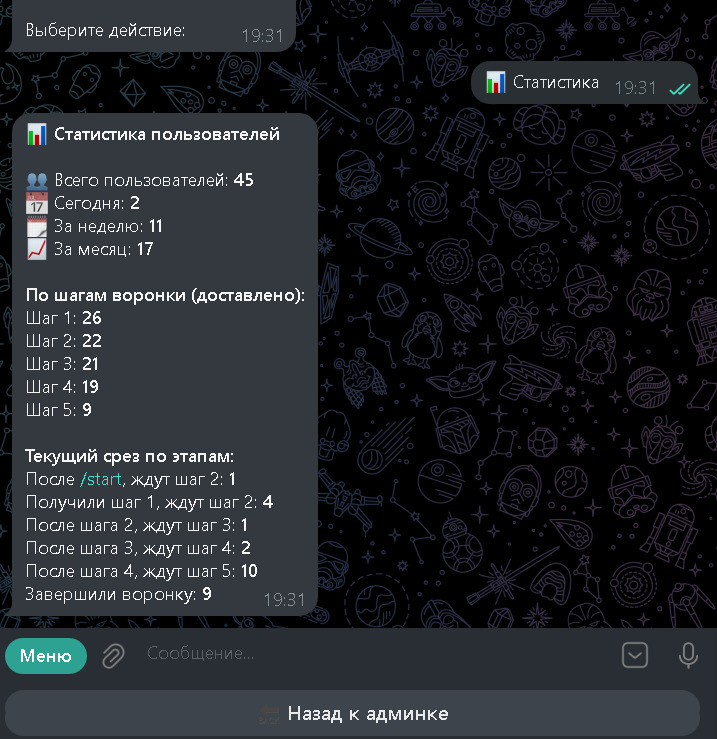
When you drive traffic to a private channel via an invite link, your analytics comes down to primitive numbers: "100 people came, 20 subscribed". That's it.
A bot gives you exact mathematics:
- How many people came?
- Where exactly did they come from (if using deep links)?
- How many people performed a specific target action inside the funnel?
- At what time, on what day of the week was the conversion higher?
This data is invaluable. It allows you to turn off non-working creatives and scale what really brings money.
🛑 Important Digression: Why we DO NOT use Inviting?
You have probably heard about such a tool as Inviting (forcibly adding users to your group/chat). Many beginners consider it a magic pill.
Why there are no and will be no guides on inviting in this course:
Inviting is an extremely aggressive, risky, and unstable promotion method. It burns out working accounts by the thousands, and users who were added to the group without their knowledge send a complaint (Spam) in 90% of cases. As a result, your group quickly gets a shadowban or is deleted.
We are for smart marketing. Using Deskgram 2 to generate traffic (via neuro-commenting, chats, and stories) with subsequent transfer to a Bot is an eco-friendly, safe, and multiply more profitable path.
This does not mean that you cannot get traffic or earn money using inviting. You certainly can, I just don't want to do this and therefore I don't want to talk about what I don't do.