Story Mentions in Telegram: How to Use Social Touch Without Direct Messaging
Telegram Story mentions are a softer touch than a direct message or a chat message. They can draw attention from a user or partner without opening a hard conversation immediately. This format is especially useful when you need to remind people about your brand, support a launch, or create a lightweight social interaction.
But Story mentions can also be ruined. If you use them at scale, without context, and with unprepared accounts, they will feel intrusive.
When Story mentions make sense
Story mentions are appropriate when there is a clear reason:
- a partner launch;
- mentioning a channel or creator;
- showing a case study;
- reacting to an ongoing discussion;
- inviting users to a guide;
- supporting an event;
- a soft touch before a future conversation.
The key question is simple: why should this person or channel be mentioned right now? If there is no answer, the mention feels random.
How Story mentions differ from direct messaging
Direct messaging starts a conversation. A Story mention works more softly: the person sees the tag, can open the story, react, or ignore it.
| Format | Strength | Risk |
|---|---|---|
| Direct message | Strong direct contact | Higher chance of feeling intrusive |
| Group message | Visibility inside a discussion | Moderation and noise |
| Comment | Topic context | Must fit the conversation |
| Story mention | Soft attention | Needs a real reason |
That is why Story mentions should not be treated as a mass replacement for DMs. They are a separate social touch layer.
How to prepare a Story mention scenario
Before launch, clarify:
- who you will mention;
- why those people are relevant;
- what the story will show;
- where the person can click next;
- whether you have a guide or web preview ready;
- which accounts will be used;
- how often the touch will repeat.
For example, if you just published a guide about Telegram Stories, a short story can show the mechanic and mention channels or partners for whom the topic is actually relevant.
What to publish in the story itself
A story with a mention has to make sense on its own. Avoid an empty background with a list of tags.
Useful story formats:
- one short insight;
- an interface screenshot;
- a guide announcement;
- a mini-checklist;
- a launch result;
- an invitation to view a module;
- a comparison of approaches.
If the story provides value, the mention feels more natural.
Common mistakes
The first mistake is mentioning too many people without a reason.
The second mistake is using the exact same template for everyone.
The third mistake is linking to an unprepared page. If someone opens the story, the next step must be obvious.
The fourth mistake is ignoring account condition. Repetitive actions from unprepared accounts reduce stability and can collide with Telegram API limits.
Example of a Story mention scenario
Suppose you publish a guide about Telegram promotion for channel owners. You can create a short story with one practical takeaway and mention a partner channel, a discussion participant, or an author whose topic aligns with the guide.
Scenario:
- Pick a real reason.
- Prepare a useful story.
- Mention relevant people.
- Link to the guide or web preview.
- Track reactions.
- Continue the conversation only with people who show interest.
That makes the mention part of a context, not a random mass action.
How to avoid crossing into annoyance
Story mentions are easy to overuse. A few simple limits help:
- do not tag people without a reason;
- do not repeat the same touch too often;
- do not use one template for everyone;
- do not overpromise in the story;
- do not send users to irrelevant pages;
- do not run the scenario through weak accounts.
If someone reacts after a mention, the follow-up should stay soft. Do not jump straight into a long sales pitch.
Mini-FAQ
Are Story mentions suitable for cold audiences?
Sometimes, yes, but only if the context is clear. With a completely random audience, the format quickly becomes pushy.
What is better: mention someone in a Story or message them directly?
A mention is softer. A DM is more direct. If the relationship is still cold, Stories can be a calmer first touch.
Should Stories be different for different segments?
Yes. Channel owners, marketers, and bot builders all need different framing and different next steps.
Story mentions in partner scenarios
Mentions work especially well in partner flows. If you are doing a joint breakdown, referencing a channel, highlighting a case, or reacting to a creator’s post, the mention feels natural.
A partner flow can look like this:
- A partner publishes a topic or creates a reason.
- You make a Story that adds value.
- You mention the partner or channel.
- You link to a guide, web preview, or discussion.
- The next communication continues only with those who reacted.
This turns the mention into part of shared content, not random poking.
How to connect mentions with CRM and audience tracking
If a Story mention gets a reaction, that is a signal. You do not need to push the person into aggressive messaging immediately, but you can mark them as a warmer contact.
Useful things to record:
- who reacted;
- which Story they reacted to;
- what the Story topic was;
- whether they clicked the link;
- whether a next contact is justified.
This turns social touch into real data for future communication.
Story mentions and web preview
Mentions work better when the Story leads to a concrete object instead of a vague landing page. In Deskgram 2 that object can be a module web preview. If someone was discussing neuro-commenting, the Story can lead directly to the neuro-commenting interface preview.
This lowers friction. The user sees the exact module instead of a generic homepage.
Segments for Story mentions
Mentions can be planned by segment:
- channel owners;
- content creators;
- marketers;
- partners;
- users who reacted before;
- discussion participants;
- niche experts.
Each segment needs its own reason. A channel owner may care about posting or Stories. A marketer may care about audience collection or AI-driven comments. A partner may care about a joint case or shared guide.
How to measure the result
Do not look only at the number of mentions. Watch the reactions:
- who opened the Story;
- who replied;
- who clicked the link;
- who subscribed;
- who asked a question;
- which segments react better.
Without this, Story mentions become activity for the sake of activity.
Where Deskgram 2 helps
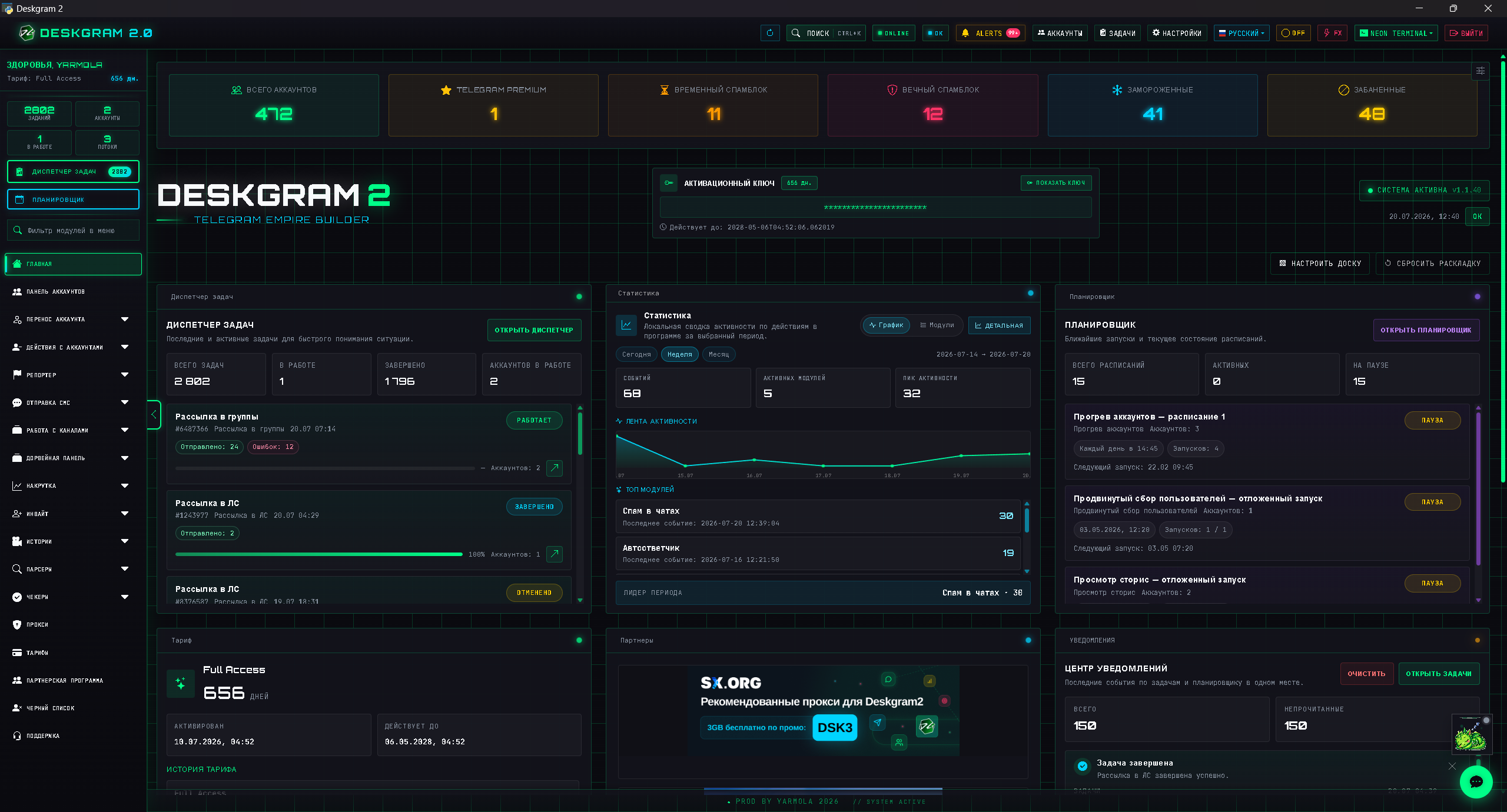
Deskgram 2 lets you use Story mentions together with other Stories modules, account management, and task control.
Useful points:
Safety and relevance rules
Story mentions should be relevant, sparse and connected to a real reason. If they are used as a hidden spam layer, they lose the main advantage of social touch.
Before scaling, check account warming, proxy rotation and audience context. Bulk messaging safety improves when mentions are used for warm touchpoints, not as a way to force attention from unrelated users.
FAQ
Who is this article for?
This article is for teams that want to use Deskgram 2 for Telegram automation, audience growth, messaging or operational workflows.
Do I need warmed accounts and proxies?
In most bulk Telegram scenarios, warmed accounts, stable proxies, conservative limits and small tests reduce risk before scaling.
Where should I test the workflow?
Use the Deskgram 2 web preview links in the article to understand the module, then start with a small controlled task before launching a larger campaign.
Conclusion
Telegram Story mentions are not aggressive outreach. They are a soft attention layer. They work best when there is a real reason, useful visual context, and a clear next step.
If you connect mentions with guides, web preview, partner scenarios, and prepared accounts, this format can strengthen the Telegram funnel without direct messaging pressure.