How to Use Similar Channels to Expand Your Niche
Searching for similar channels is one of the most useful ways to expand Telegram discovery. It helps you move beyond obvious keywords and find sources that are connected to your audience through interests, topics, or behavior.
If standard search answers the question “what was found by this keyword,” similar channels answer another one: “which other sources sit next to an already proven channel?” For growth, that is extremely valuable, because strong audiences often live outside the most obvious queries.
Why search for similar channels
If you work only with keywords, it is easy to get stuck in shallow results. For example, the query “Telegram marketing” will show obvious promotion channels. But nearby you may also find sources about bots, Mini Apps, sales, SMM, content, advertising, automation, and CRM.
Similar channels help you:
- expand the niche map;
- find new audience sources;
- spot adjacent topics;
- pick donor sources for parsing;
- find channels for comments;
- understand where else your audience spends time.
This is not a replacement for manual analysis. It is a discovery accelerator.
Where to start
To search for similar channels, you need a strong seed channel. If the original channel is weak, the similar results may drift in the wrong direction too.
A strong seed usually:
- is tightly related to your topic;
- publishes content regularly;
- has a clear audience;
- does not look artificially inflated;
- includes reactions or discussion;
- fits the next workflow.
Do not choose the first large channel just because of size. It is better to choose a source that is genuinely close to your audience.
How to build a niche map
After finding similar channels, do not just save a list. Sort it into clusters.
For Telegram growth, the clusters may look like this:
| Cluster | Meaning |
|---|---|
| SMM and marketing | Audiences working on promotion |
| Telegram Ads | Interest in paid traffic |
| Bots and Mini Apps | Technical and product-focused audience |
| Arbitrage and traffic | Performance segment |
| Channel owners | Potential users of management modules |
| AI and automation | Audience for neuro-modules |
This kind of map helps you understand which segments should be developed separately and which ones should not be mixed.
How to use similar channels afterward
Similar channels can feed different workflows.
If a channel is active and has comments, you can use it for neuro-commenting or comment-based audience collection. If it has a linked chat, you can collect users who wrote there. If a channel matters as a competitor or media source, you can add it to monitoring and content analysis.
Practical sequence:
- Find a strong seed channel.
- Get the list of similar channels.
- Split the results into clusters.
- Remove weak or irrelevant sources.
- Pick channels for parsing, comments, or analysis.
- Pass the selected sources into the next module.
That turns similar-channel search into part of the funnel rather than a standalone spreadsheet.
Example of niche expansion
Suppose the seed channel is focused on Telegram growth. Similar-channel search can lead you not only to direct competitors, but also to adjacent segments:
- channels about Telegram Ads;
- channels about bots;
- channels about Mini Apps;
- SMM communities;
- arbitrage channels;
- channels about AI tools;
- chats for Telegram channel owners.
Each segment can be used differently. Channel owners care about publishing, audiences, and monetization. Arbitrage teams care about traffic, tests, and speed. Developers care more about bots, Mini Apps, and integrations. If you mix them into one base, the message becomes too generic. If you separate them, you can build more precise workflows.
How to connect similar channels to content strategy
Similar channels are useful not only for parsing. They help you understand which topics keep repeating in the niche and where there are still unanswered questions.
Things to analyze:
- which headlines earn reactions;
- which questions repeat in comments;
- which formats competitors use;
- which topics are overheated;
- which adjacent themes you can cover with your own guides;
- where the user should go after the first touchpoint.
This is where discovery starts helping not only Telegram operations, but also your website SEO, blog content, and product pages.
How to clean similar-channel results
Similar channels are not always useful channels. Algorithmic proximity may surface sources that are formally close, but wrong for your job.
Check that:
- the channel topic really matches the needed segment;
- the content is fresh;
- the audience looks alive;
- the channel is not almost entirely advertising;
- comments or a linked chat exist;
- the source fits a later workflow.
It is especially important to separate channels for analysis from channels for action. Some sources are useful only as idea generators and are poor fits for audience collection.
Mistakes
The first mistake is expanding the niche endlessly. If you drift too far from the original theme, the base becomes blurry.
The second mistake is not recording which seed led to a given channel. Later it becomes hard to understand why the source entered the list.
The third mistake is mixing every discovered channel into one scenario. Similar channels may belong to very different segments and require different actions.
The fourth mistake is skipping manual quality review. Automated discovery speeds up the work, but the final decision still has to account for what the channel actually is.
Mini FAQ
Can you build the whole base only through similar channels?
It is better to combine approaches. Keywords create the starting map, similar channels expand it, and manual cleanup keeps you away from irrelevant segments.
What if similar channels drift into another topic?
Go back to the seed channel and check whether it was precise enough. Often the problem is not the similar-source search, but a weak starting point.
Are similar channels useful for advertising?
Yes. They help analyze ad placements and competitors, but before buying anything you still need to validate audience quality, content, and the reputation of the channel.
Where Deskgram 2 helps
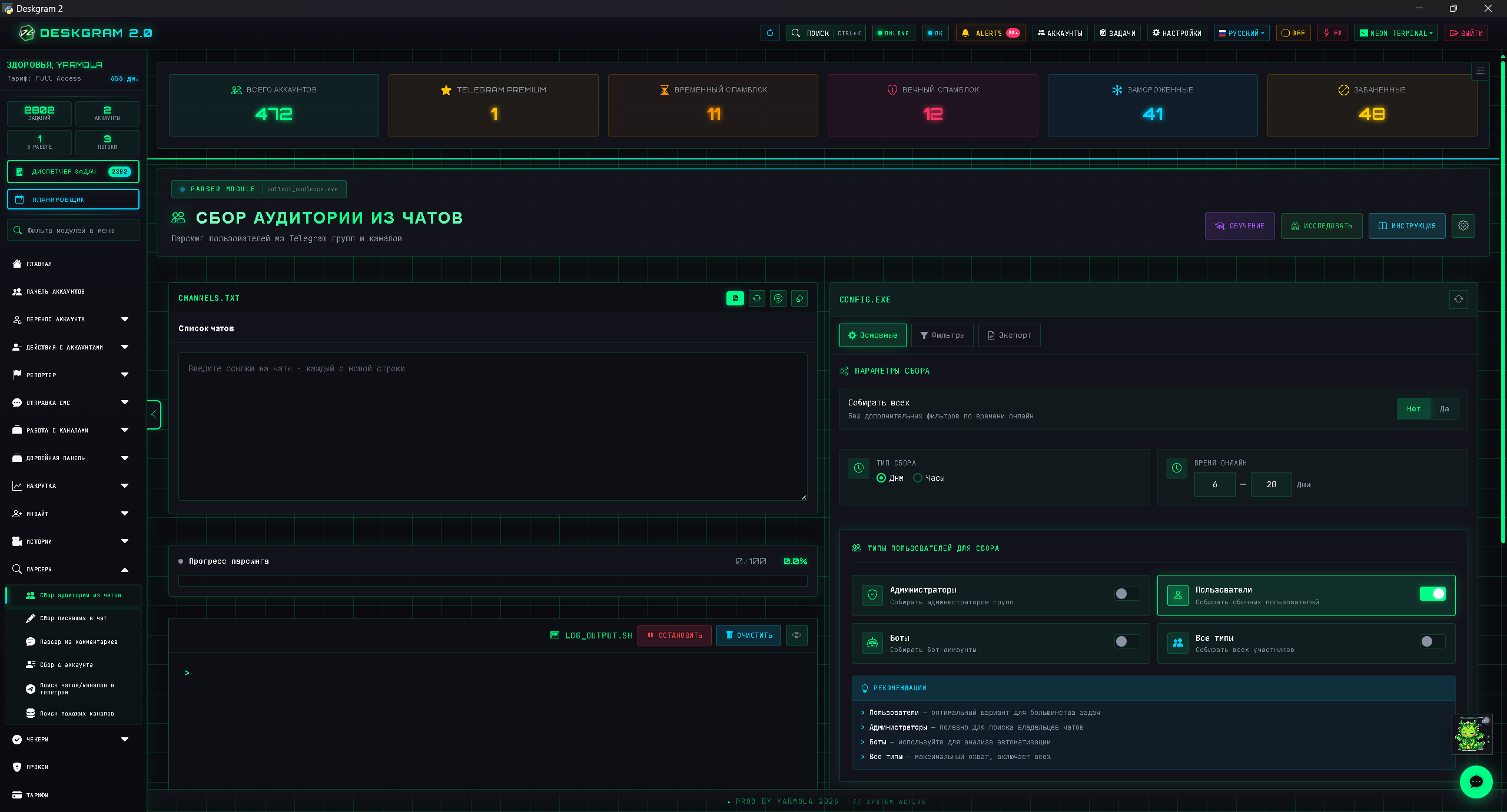
In Deskgram 2, similar-channel search can be combined with channel and group discovery, audience collection, comment collection, and neuro-commenting. That lets you move quickly from one strong source to a full map of the niche.
Useful web previews:
From discovery to automation
Similar-channel search becomes commercially useful when it feeds a safe Telegram automation workflow. After finding sources, collect and segment users, check audience quality, prepare accounts with account warming and keep proxy rotation predictable.
The next step should respect Telegram API limits and start with a small batch. This keeps discovery from turning into uncontrolled scraping and protects bulk messaging safety when the team moves from research to outreach.
Conclusion
Similar channels help you expand a Telegram niche not blindly, but from already validated sources. This is especially useful when keywords produce only obvious or overheated results.
If you preserve seed channels, clean the results, and split sources by scenario, similar-channel search becomes a strong tool for audience discovery, market analysis, and the next automation workflows.
The best results appear when similar-channel search is used regularly. Over time, the team builds a living map of the niche: which sources are growing, which topics keep repeating, where new discussions appear, and which channels should feed the next growth scenarios.