How to Build a Safer Telegram Funnel: Discovery -> Parser -> Outreach
Many teams begin Telegram promotion from the final step: the message itself.
It seems that if you already have text and a list of users, you can launch communication immediately. In reality, the quality of messaging is almost always determined by what happened before it.
If the audience sources are weak, the base will be weak. If the base is weak, outreach turns into chaotic spam. If there is no next step after the first message, even good replies start getting lost.
That is why a more effective logic looks like this:
discovery -> parser -> base cleaning -> outreach -> autoresponder or botIn this article we break down how to build that funnel: where to look for sources, when to use a parser, how not to collect garbage, and how to move into communication without unnecessary noise.
What discovery -> parser -> outreach actually means
This chain has three major stages.
| Stage | What it does | Why it matters |
|---|---|---|
| Discovery | Finds channels, groups, and sources in the niche | Without good sources, the base becomes random |
| Parser | Collects an audience from those sources | Turns a niche map into a user list |
| Outreach | Creates the first touch: DMs, groups, autoresponder, or bot | Turns the base into dialogues and clicks |
The core idea is simple: outreach does not begin with the message. It begins with the quality of the source.
If you collect people from the wrong channels, even strong copy will not save the result.
Why the base matters more than the first message
Copy matters. But it cannot compensate for a bad base.
Imagine two scenarios.
Scenario 1. The base is collected chaotically
- channels are chosen randomly;
- the audience is not segmented;
- part of the users are inactive;
- the topic of the source does not match the offer;
- the base is too broad.
In this situation, the campaign starts feeling like noise.
Even if the message is decent, it lands in the wrong place.
Scenario 2. The base is built through discovery
- sources are selected by niche first;
- similar channels expand the map;
- the parser collects relevant users;
- the base is cleaned;
- outreach goes to a clear segment.
Now it becomes possible to test copy, autoresponders, AI, bots, and different touch strategies.
The difference is not magic. The difference is context.
Stage 1. Discovery: find the right sources
Discovery answers one question:
where does the target audience already live inside Telegram?
That may include:
- competitors’ channels;
- niche groups;
- chats in the same vertical;
- expert channels;
- local communities;
- channels with active comments;
- spaces where users already discuss related problems.
How to begin source search
Start by collecting clusters of keywords, not just one broad keyword.
Useful clusters:
- the main niche;
- the client problem;
- product or category names;
- competitors;
- adjacent topics;
- audience slang.
For example, if you promote a B2B service, searching only for “business” is too vague. A stronger set might include CRM, sales, lead generation, agencies, SaaS, and automation.
What to check in found channels
Do not simply take every result. Evaluate quality:
- is there a real audience;
- does the topic match the offer;
- are comments active;
- does the channel look artificially inflated;
- are there similar sources around it;
- can an audience actually be collected from it.
For the first step, the Deskgram 2 channel and group search module is useful:
Stage 2. Expand through similar channels
Once you already have the first strong sources, you can expand the niche map.
This is where similar-channel search becomes valuable.
The logic is simple:
find 10 strong channels -> find similar ones -> filter the best -> build the niche mapThis helps you avoid relying only on the initial keywords.
Sometimes the strongest sources are not found through direct search, but through neighboring channels and audience overlap.
When similar channels are especially useful
- the niche is narrow;
- direct keywords produce too few results;
- you already have 3-5 strong competitor channels;
- you need to expand the donor source base;
- you need places for comments or parsing.
If discovery is reconnaissance, similar channels are map expansion.
Stage 3. Parser: move from sources to people
After discovery, you have a list of sources.
But channels and groups by themselves are not yet a communication base.
You still need to decide whom to collect:
- group members;
- commenters;
- active users;
- people who wrote in chats;
- audiences of specific channels;
- users filtered by activity.
This is where the parser layer begins.
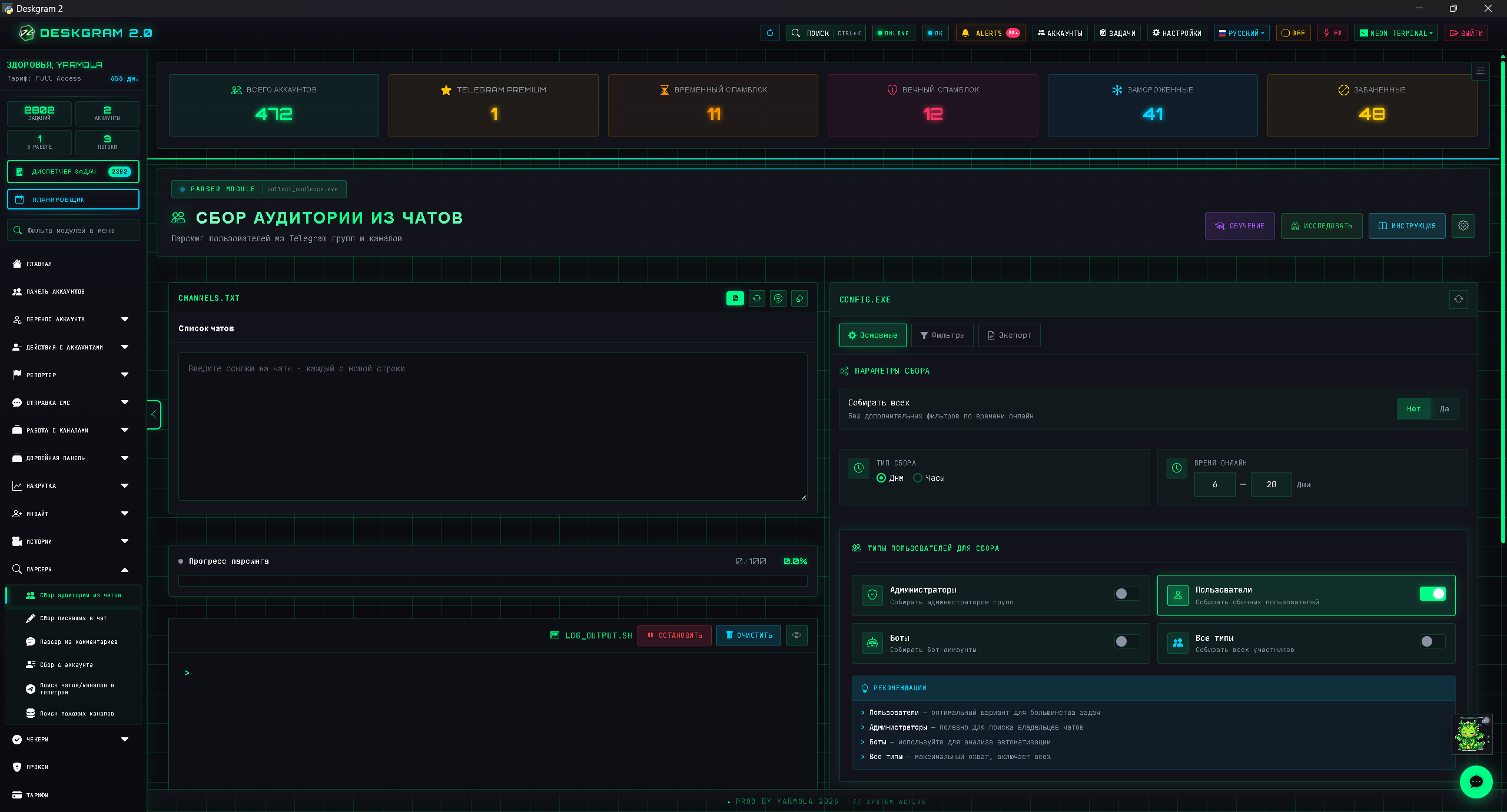
In Deskgram 2, several scenarios support this:
- audience collection;
- advanced audience collection;
- collection from comments;
- collection of people who wrote in chats;
- collection of active users.
The core rule of parsing
Not everyone you can collect should actually be collected.
If participant lists are hidden, it is better to use activity-based collection. If warmer users are needed, comments and chat participants are often stronger. If a broad base is needed, classic audience collection is a reasonable starting point.
Open the audience collection module:
Stage 4. Clean and segment the base
After parsing, do not launch messaging immediately.
First, the base has to be brought into working condition.
Things worth checking:
- duplicates;
- clearly irrelevant users;
- bots;
- activity that is too old;
- users without the needed signal;
- multiple segments inside one base.
Segmentation becomes especially important when you have several offers or multiple audience types.
Examples:
- commenters from large channels;
- participants of narrow groups;
- users who wrote in chats;
- competitors’ audiences;
- users with fresher activity.
Each segment can receive its own copy and its own next step.
Stage 5. Prepare accounts before outreach
Even a strong base can be ruined by weak delivery.
Before outreach, check:
- which accounts will be used;
- whether they are warmed up;
- which proxies are attached;
- what load they can tolerate;
- how many messages per account;
- what delays are configured;
- what to do in case of flood limits.
If accounts are new or have been inactive for a long time, it is better to warm them up first.
Open account warm-up:
Stage 6. Outreach: the first touch must have a purpose
Outreach is not only about sending a message.
The first touch should have a purpose:
- get a reply;
- move the user into a bot;
- share a resource;
- send them to a channel;
- route them to a manager;
- activate the autoresponder;
- test interest.
If the goal is not clear, the copy becomes blurry.
What to prepare before messaging
- the first message;
- variation or spintax;
- the link or next step;
- the autoresponder;
- limits;
- delays;
- exclusions;
- a test on 1-2 accounts.
Open direct messaging:
Safety checkpoints between stages
Each stage should pass a small checkpoint before the next one starts:
- Discovery should produce relevant sources, not just many sources.
- Parser output should be segmented and cleaned.
- Outreach accounts should pass account warming.
- Proxies should be checked before the first campaign batch.
- Telegram API limits should be conservative during the first test.
- Replies should route into an autoresponder, AI chatting or support flow.
This is how bulk messaging safety becomes part of the funnel instead of a warning added after something breaks.
FAQ
Who is this article for?
This article is for teams that want to use Deskgram 2 for Telegram automation, audience growth, messaging or operational workflows.
Do I need warmed accounts and proxies?
In most bulk Telegram scenarios, warmed accounts, stable proxies, conservative limits and small tests reduce risk before scaling.
Where should I test the workflow?
Use the Deskgram 2 web preview links in the article to understand the module, then start with a small controlled task before launching a larger campaign.
Conclusion
A safer Telegram funnel is not built from one message. It is built from source quality, sensible parsing, segmentation, prepared accounts, and a clear next step.
When discovery, parser, and outreach are connected into one system, Telegram promotion stops feeling random and starts becoming measurable, repeatable, and commercially useful.