Telegram Direct Messaging: How to Run Outreach More Carefully and With Less Chaos
Telegram direct messaging remains one of the most direct ways to reach an audience. That is also exactly why it requires discipline. If you launch private messages as rough mass outreach without audience quality checks, account warming, Telegram API limits, or a real scenario, the result quickly turns into complaints, weak replies, and burned accounts.
It is more useful to view direct messaging as the last downstream layer of the funnel. First comes source discovery, then audience parsing and filtering, then account preparation, and only after that should you launch test communication.
When direct messaging makes sense
Private messages do not fit every task. They work best when you have a clear reason to contact a person.
Good scenarios:
- the user wrote in a thematic chat;
- the person left a comment under a relevant post;
- the audience was collected from a narrow niche;
- the message offers one clear benefit;
- there is a next step: bot, form, web preview, consultation, or guide.
Weak scenarios:
- the audience was collected without context;
- the same copy is sent to every segment;
- the offer does not match the user's interest;
- the accounts are new and unprepared;
- there is no reply handling after inbound messages.
If a person does not understand why you contacted them, even a well-written message will still feel like spam.
What to prepare before launch
Before launching a messaging run, you need to verify more than just the copy. The full operational chain matters.
A minimum checklist:
- the audience comes from understandable sources;
- segments are separated clearly;
- accounts are added and checked;
- proxies are configured properly;
- account warming is done or at least planned;
- limits and delays are not aggressive;
- an autoresponder or manual reply process is ready;
- a small test group is prepared before scaling.
Direct messaging should not begin at maximum volume. It is safer to start with a small segment and inspect how people react.
Why audience quality matters more than copy
Copy matters, but audience quality matters more. Even a strong message performs poorly when it lands in a random audience. On the other hand, a simple message can work well when it matches the user's context.
A weak example:
Hi! We have a Telegram promotion service. Interested?
This is too generic. It does not explain why the person received it.
A more precise approach:
Hi. I saw you discussing audience collection from Telegram chats. We recently built a workflow around source discovery, active-user parsing, and careful outreach. If it is relevant, I can send a web preview of the exact module.
The difference is not only wording. The second version uses source context.
Limits, delays, and bulk messaging safety
Limits are not there for formality. They help prevent an account from looking like a one-pattern messaging machine. The more aggressive the pace, the higher the risk of restrictions and the worse the quality of inbound reply handling.
The right settings depend on account age, account history, proxies, proxy rotation strategy, audience quality, and the scenario. But the general rule stays simple: start small, inspect signal, and scale only the combinations that already work.
Things to watch:
- delay between messages;
- number of messages per account;
- pauses between tasks;
- load distribution across accounts;
- user reactions;
- errors and restrictions in logs.
If a campaign produces repeated failures, do not just add more accounts. First identify the cause: audience quality, copy, limits, proxies, or account state.
Why an autoresponder matters
Messaging without reply handling often loses half of its value. If a user replies, the system should quickly move that person to the next step: send a link, clarify interest, share a guide, offer a demo, or hand off to an operator.
An autoresponder is especially useful when:
- you are testing several audience segments;
- inbound volume is higher than manual handling can support;
- you need a fast first reply;
- the same questions repeat often;
- the user should move to a bot or a website.
At the same time, an autoresponder should not sound dead or robotic. It is better to prepare several flows for different reactions: interest, pricing question, request for an example, refusal, or a request to write later.
How to write the first message
The first message should be short and clear. Its job is not to sell the whole product immediately, but to open a normal dialogue. Telegram users usually react badly to long promotional walls of text, especially in a cold contact.
A good first-message structure:
- Short context for why you are writing.
- One understandable benefit.
- A soft next step.
- An easy way to decline without pressure.
Example:
Hi. I found you in a discussion about Telegram growth. We built a tool for channel discovery, audience collection, and careful communication in Telegram. I can send a web preview of a specific module so you can inspect the interface without installing anything.
This will not fit every niche, but it contains the key elements: source context, a clear topic, and a low-friction next step.
How to test combinations
Do not launch one text across the whole audience. It is better to prepare several hypotheses and test them on small segments.
You can test:
- different reasons for the first contact;
- different audience segments;
- a link to a web preview versus a link to a guide;
- a short message versus a slightly more explanatory one;
- manual replies versus an autoresponder;
- different sending time windows.
After the test, do not focus only on the number of replies. It is more useful to assess dialogue quality: how many people understood the offer, how many asked a useful question, how many clicked the link, and how many asked for an example.
How to connect direct messaging with web preview
One of the strongest moves for Deskgram 2 is to avoid asking a person to install anything right away. Instead, let them inspect the relevant module in a browser. That reduces friction: the user can open the interface, understand the logic, and decide whether the tool fits the task.
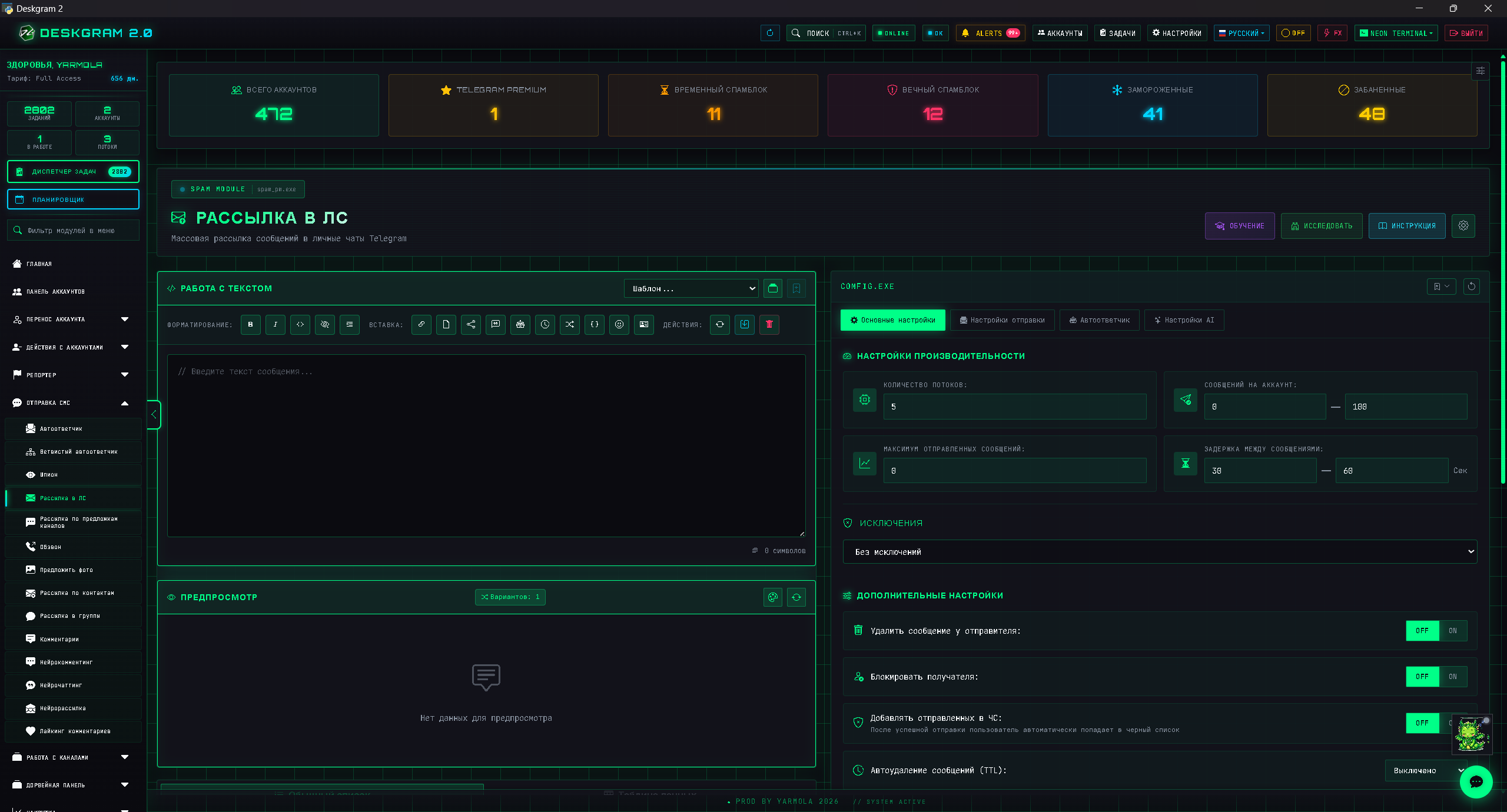
For example, in a direct messaging scenario you can lead the user to the private messaging module web preview or to the broader Deskgram 2 overview.
That kind of transition works well in soft outreach:
- Short message with context.
- Link to the relevant module.
- Answer to the user's question.
- Move into a bot, the site, or a personal consultation.
Common mistakes
The first mistake is launching campaigns on a cold, unsegmented audience. In that case even a useful offer feels random.
The second mistake is writing overly promotional copy. In Telegram, messages work better when they sound like a normal human contact: short, relevant, and clear.
The third mistake is not preparing reply handling. If the person becomes interested but receives a reply a day later or no reply at all, the funnel loses its meaning.
The fourth mistake is scaling before testing. First you need to understand which segment and which copy produce signal. Scaling chaos is the most expensive way to learn.
A practical launch workflow
A working sequence can look like this:
- Find channels and chats in the niche.
- Collect an audience from active sources.
- Split the audience into segments.
- Check accounts and proxies.
- Run account warming or use already prepared accounts.
- Prepare 2-3 message variants.
- Launch a small test.
- Process inbound replies through an autoresponder or manually.
- Keep only the combinations that produce healthy reactions.
This is slower than crude mass blasting, but much more stable.
Where Deskgram 2 helps
In Deskgram 2, direct messaging can be connected with the accounts panel, proxies, account warming, audience collection, task control, and the autoresponder. That matters because Telegram direct outreach rarely works in isolation. You need not just one button, but a controlled stack.
Useful modules:
FAQ
Who is this article for?
This article is for teams that want to use Deskgram 2 for Telegram automation, audience growth, messaging or operational workflows.
Do I need warmed accounts and proxies?
In most bulk Telegram scenarios, warmed accounts, stable proxies, conservative limits and small tests reduce risk before scaling.
Where should I test the workflow?
Use the Deskgram 2 web preview links in the article to understand the module, then start with a small controlled task before launching a larger campaign.
Conclusion
Telegram direct messaging can be a useful growth tool when it is built into a real funnel: quality sources, segmentation, warmed accounts, Telegram API limits, tests, and reply handling.
The main idea is simple: do not start with volume. Start with relevance. That is what turns direct messages from chaotic spam into a controlled communication channel with a clear audience and a measurable next step.