Posting to Telegram Channels: How to Manage Publications Through an Account Grid
Posting to Telegram channels looks simple while you only have one channel and a few posts per week. But once you have a channel grid, multiple accounts, content series, publishing schedules, and several promotion scenarios, the manual approach starts to break.
Posting should not be treated as a single "publish" button. It is part of a content infrastructure where account roles, scheduling, task control, copy quality, and funnel logic all matter: where the post sends the user, what the next action is, and how the result will be measured.
When managed posting becomes necessary
Managed posting is useful if:
- you have more than one channel;
- publications go out on a regular basis;
- you run several rubrics or content streams;
- content is tied to product promotion;
- you want to lead users to guides, a bot, the site, or web preview;
- publications are launched through different accounts;
- repetition rules, schedules, and error control matter.
If publications are chaotic, content stops supporting marketing. A channel may stay active, but it no longer moves users toward a clear next step.
What to prepare before publishing
Before launching posting, describe not only the text, but the system behind it.
Minimum checklist:
- channel list;
- account roles;
- topics and rubrics;
- publication frequency;
- links to landing pages;
- links to guides;
- links to module web previews;
- repeat rules;
- task and log monitoring.
It is especially important to understand in advance which posts are educational, which posts push the product, and which ones are meant to build trust.
Content series work better than random posts
One accidental publication rarely produces a strong result. Series work better.
Examples of content series:
- Deskgram 2 module breakdowns;
- Telegram promotion mistakes;
- audience collection tutorials;
- account warm-up and safety cases;
- format or strategy comparisons;
- short checklists;
- answers to common questions.
A series trains the audience to follow the logic of the channel. Users see not a one-off post, but a sequence of materials.
How to connect posting with SEO guides
Site articles and Telegram posts should strengthen each other. A guide on the site closes a long search query, while a Telegram post can become the short entry point into the topic.
Example flow:
- A site article about audience collection is published.
- A short Telegram post highlights the core mistake.
- The post links to the full guide.
- The guide links to a module web preview.
- The user can inspect the interface before installing anything.
This way the content system moves a person from a short touchpoint to a deeper resource and then to the product.
The role of tasks and schedules
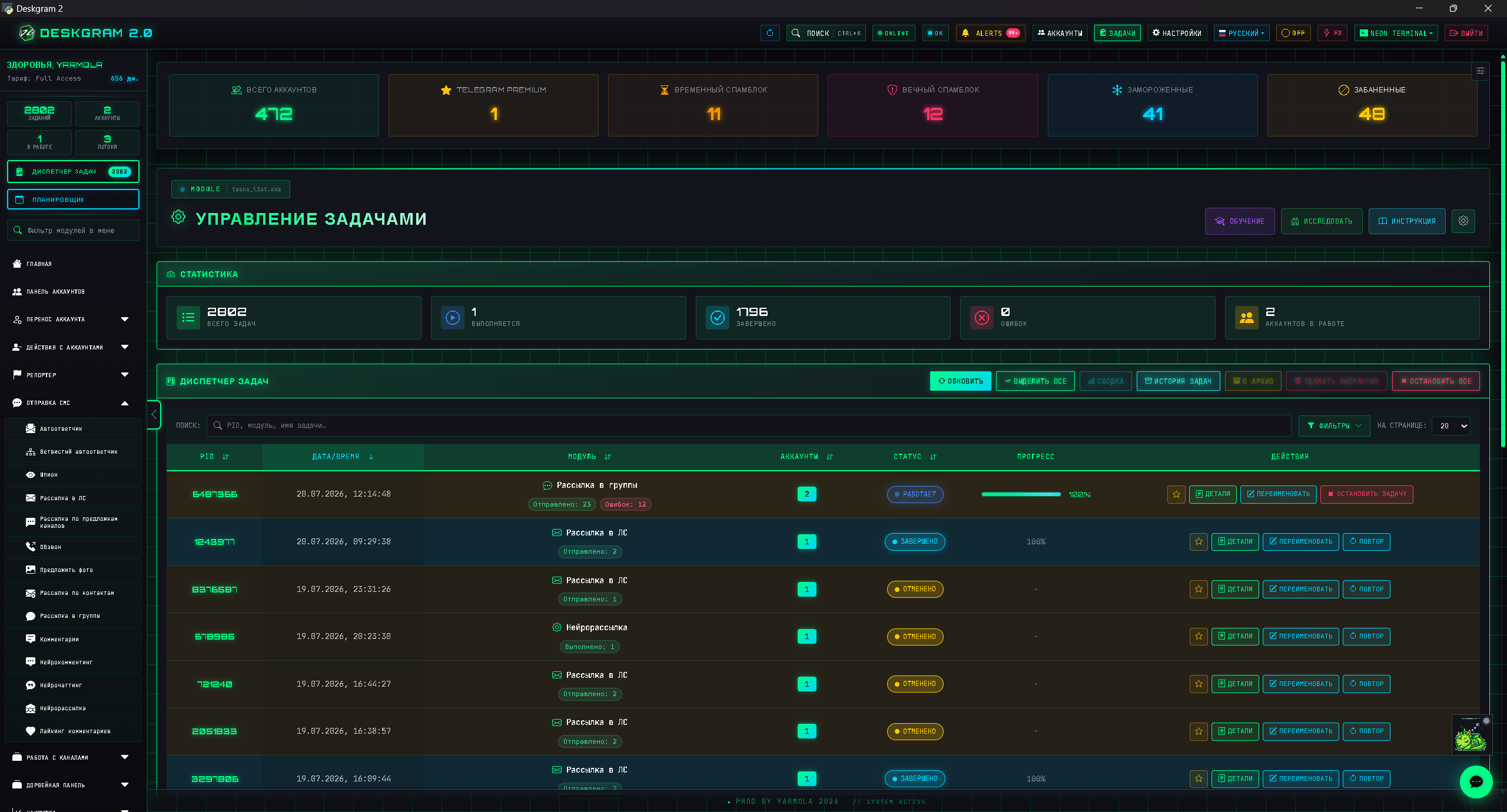
If you publish a lot, you should not keep everything in your head. A planner and task dispatcher make it easier to see what is already published, what is scheduled, and where errors appeared.
Useful fields to track:
- publication date;
- channel;
- topic;
- link;
- text version;
- owner;
- task status;
- result.
This matters even more if content is produced for different segments: channel owners, marketers, affiliate teams, agencies, or bot builders.
Common posting mistakes
The first mistake is publishing without strategy. A large number of posts does not automatically mean strong content.
The second mistake is not giving the user a next step. If a post is disconnected from a guide, bot, site, or web preview, it quickly disappears into the feed.
The third mistake is mixing every topic in one channel without categories. The audience stops understanding what to expect.
The fourth mistake is ignoring results. Posting should generate signals: clicks, questions, saves, replies, and leads.
Example of a content week
To avoid turning the channel into a random feed, plan publications as a small series.
| Day | Format | Goal |
|---|---|---|
| Monday | Mistake of the week | Show the problem |
| Tuesday | Mini-guide | Give a practical fix |
| Wednesday | Interface screenshot | Connect the topic to the product |
| Thursday | FAQ | Handle objections |
| Friday | Link to the full guide | Lead traffic to the site |
| Saturday | Stories or short takeaway | Keep the topic alive |
| Sunday | Weekly wrap-up | Tie materials into one chain |
This makes content easier to plan and also links your Telegram channel to the site, guides, and web preview.
How to measure posting quality
Reach matters, but reach alone does not show commercial value. You need to see what the publication does to the funnel.
Useful signals:
- clicks to the guide;
- clicks to web preview;
- direct questions or bot messages;
- saves;
- reposts;
- comments;
- leads;
- repeat touches.
If a post gets reach but does not move the user forward, review the CTA, the angle, or the linked page.
Mini-FAQ
Do you need to post every day?
Not necessarily. Structure and consistency matter more. Three strong posts per week are often better than daily noise.
Can AI help prepare posts?
Yes, but the final copy still has to match the audience, the product, and the next step. AI helps with drafts, yet it does not replace strategy. This is where LSI details such as account warming, proxy rotation, Telegram API limits, and bulk messaging safety should be integrated naturally when relevant.
Where should channel posts send traffic: to the site or to web preview?
If the user is still learning the topic, send them to a guide. If they already understand the problem, web preview can work as a faster conversion step.
How posting supports the wider SEO system
Telegram posts can strengthen the site if they do not live in isolation. Every new article can receive a short version inside the channel, a story series, and a link to web preview. That creates several entry points for one topic.
For example, a large article about account warm-up can be turned into:
- a short post with the main takeaway;
- a checklist inside the channel;
- a story with interface screenshots;
- a link to the warm-up module;
- a discussion in comments;
- a message asset for older leads.
This means one SEO article becomes the content core for Telegram, not just a standalone site page.
How to avoid burnout with regular posting
The main problem with regular posting is usually not the lack of ideas, but the lack of system. If every post is invented from scratch, the channel quickly becomes exhausting.
It is easier to work in batches:
- Pick the topic of the week.
- Write one large material.
- Split it into three to five short posts.
- Add stories.
- Prepare an FAQ.
- Collect audience questions for the next article.
This makes content reusable instead of constantly starting from zero.
Where Deskgram 2 helps
Deskgram 2 helps manage publications as part of a broader system: accounts, tasks, schedulers, and promotion modules work together.
Useful points:
FAQ
Who is this article for?
This article is for teams that want to use Deskgram 2 for Telegram automation, audience growth, messaging or operational workflows.
Do I need warmed accounts and proxies?
In most bulk Telegram scenarios, warmed accounts, stable proxies, conservative limits and small tests reduce risk before scaling.
Where should I test the workflow?
Use the Deskgram 2 web preview links in the article to understand the module, then start with a small controlled task before launching a larger campaign.
Conclusion
Posting to Telegram channels works much better when it is built into a system: rubrics, schedules, links, guides, web preview, and task control. Then publications stop being feed fillers and start moving users through the funnel.
When you treat posting as content infrastructure, your channels begin to support SEO, product pages, outreach, and brand trust at the same time.