Telegram Autoresponder: Rules, Branches, and the AI Layer
A Telegram autoresponder is not there to replace human communication completely. Its job is to process typical reactions quickly, avoid losing an interested user, and move that user to the next step. This becomes especially important after direct campaigns, comments, ads, and other scenarios where inbound messages grow faster than a team can handle manually.
A strong autoresponder does not feel like a robotic wall of text. It behaves more like a dispatcher: it understands the type of request, gives a short answer, offers an action, and hands the person over when needed.
Where an autoresponder is especially useful
Autoresponders are valuable in scenarios such as:
- after direct messaging campaigns;
- after contact-based outreach;
- after traffic from ads;
- when product questions repeat often;
- when users need quick links to guides or web preview;
- for basic qualification of interest;
- for collecting leads before manual handling.
If a user replies and gets no reaction, interest cools down quickly. An autoresponder closes that gap.
Rules and branches
A basic autoresponder starts with rules: if the user writes one kind of phrase, the system answers in a matching way. But to make the scenario useful, those rules should be grouped into branches.
Examples of branches:
| Branch | User signal | Response |
|---|---|---|
| Interest | “yes”, “send it”, “sounds relevant” | Link to a module or guide |
| Price | “how much”, “pricing” | Short explanation and next step |
| Demo | “can I see it?” | Link to web preview |
| Refusal | “not interested” | Polite close |
| Operator | Complex question | Human handoff |
Branches stop you from replying to everyone in exactly the same way.
How to keep the autoresponder from becoming annoying
The main mistake is overwhelming the user with long templates. In Telegram, short replies that move the person toward a clear action usually work better.
Principles:
- answer the actual question;
- avoid sending several long messages in a row;
- do not argue with refusal;
- send one link at a time;
- explain what the user gets after the click;
- leave room for a real human contact.
If the person asks about a module interface, it is usually better to send web preview than a five-screen sales monologue.
Where the AI layer helps
The AI layer is useful when user questions vary too much for simple rules alone. But AI should never work without guardrails. It needs context, limits, and clarity about where the user should go next.
AI can help with:
- rephrasing the response;
- identifying intent;
- soft qualification;
- explaining what a module does;
- drafting help for an operator;
- handling unusual questions.
The best model is a combination of rules and AI. Rules handle obvious cases, while AI covers the free-text edge cases.
How autoresponders connect to outreach
Autoresponders matter most after outbound campaigns. If a messaging campaign generates replies but the system is not ready to process them, part of the result is lost.
Before campaign launch, prepare:
- answers to common questions;
- a web preview link;
- a guide link;
- a pricing scenario;
- a refusal scenario;
- an operator handoff path;
- stop words and exclusions.
Then direct messaging and the autoresponder work as one scenario instead of two disconnected mechanics. This is especially important for bulk messaging safety, because sloppy reply handling often ruins the value of otherwise decent traffic.
Example of a simple reply flow
Imagine you sent a message about the audience collection module. Users may react in different ways: some ask for a link, some ask about price, some want to know whether it is safe, and some simply say “not interested.”
A simple structure:
- If the user wants to see it, send the module web preview.
- If the user asks about safety, give a short explanation about sources, limits, account warming, and proxy rotation.
- If the user asks about price, route them to the current pricing page or a manager.
- If the user refuses, close politely.
- If the question is complex, hand it off to an operator.
Even this basic structure removes a lot of post-campaign chaos.
How to prepare the answer base
Before launching the autoresponder, list ten to twenty common questions. Do not try to cover every edge case on day one. Start with the questions that appear most often.
Typical needs include:
- what the product is;
- how to see the interface;
- which modules exist;
- how safety works;
- how it differs from manual work;
- how much it costs;
- whether a test is possible;
- what to do when a specific module is needed.
The better the answer base is prepared, the less AI has to invent.
Common mistakes
The first mistake is making the autoresponder too long. The user asks a short question and gets a wall of text.
The second mistake is ignoring refusal. If someone says “not interested,” the system should not keep pushing them through more warming messages.
The third mistake is dropping several links at once. One clear next step is usually much better.
The fourth mistake is failing to hand complex questions to a human. Automation is useful only until it starts arguing or overpromising.
Mini-FAQ
Does an autoresponder replace a manager?
No. It handles repetitive questions and helps process inbound messages faster, but complex situations should still go to a human.
Do all autoresponders need AI?
Not always. For very simple flows, rules may be enough. AI matters more when users write in free text and the intent is less predictable.
What matters more: speed or quality of response?
You need both. A fast but irrelevant answer is frustrating. A short precise answer with a clear next step works better.
Where Deskgram 2 helps
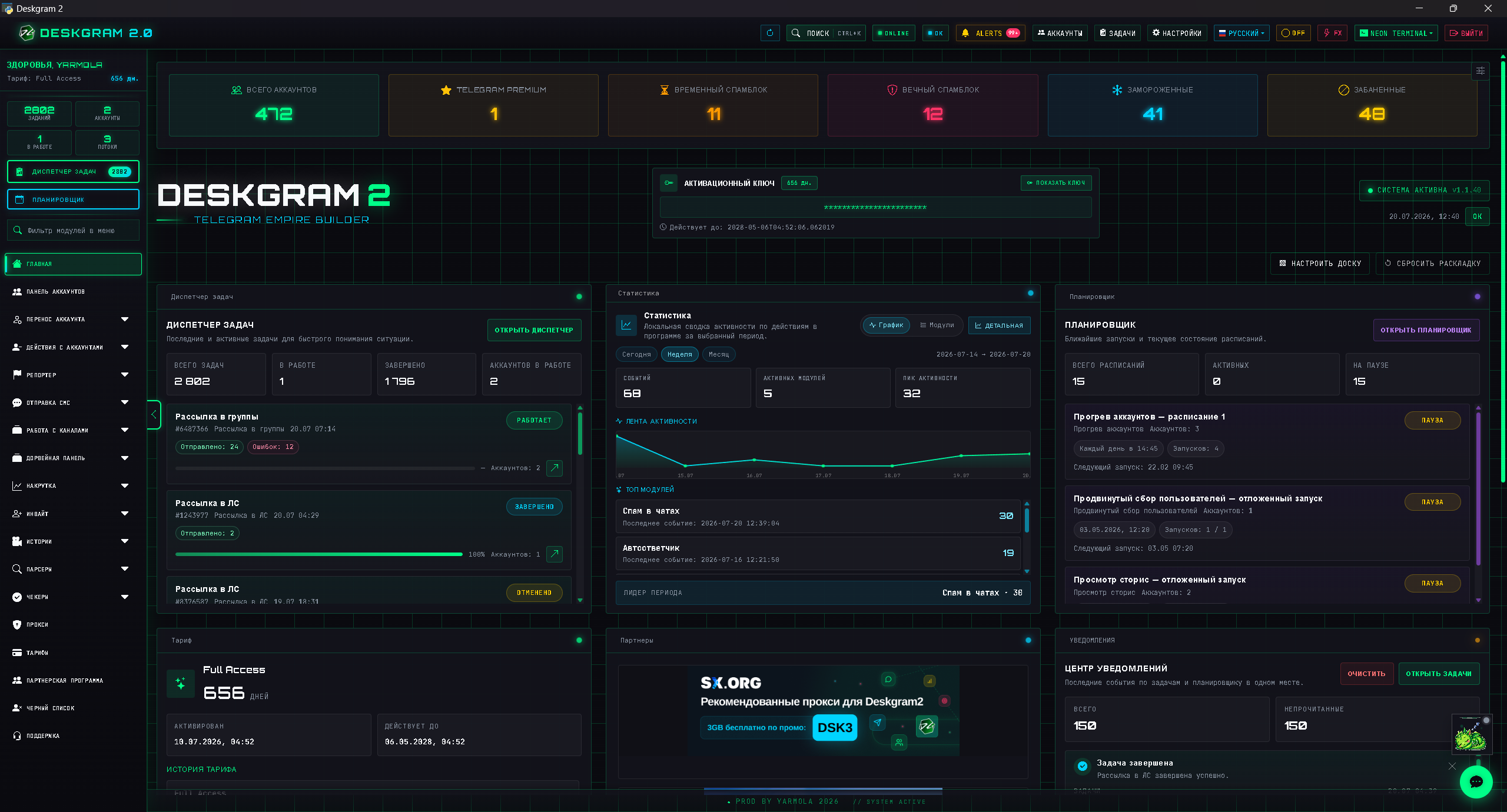
In Deskgram 2, the autoresponder can be connected to direct messaging, neuro-chatting, task flows, and module web previews. That is useful when the user should receive a specific link or explanation quickly.
Useful points:
How to place it inside the wider funnel
The best time to prepare an autoresponder is before the active campaign begins, not after. If you send messages first and only then start thinking about what to tell people, some of the result is already lost.
The healthier sequence looks like this: prepare the audience base -> write the first message -> collect common questions -> configure the autoresponder -> run a test -> inspect real replies -> improve the branches. After that, scaling becomes much calmer.
Autoresponders are also valuable for site traffic and guides. If a user arrives from an article and asks about a specific module, the system should not retell the whole product. It should route that person quickly to the right guide, web preview, download page, or human contact.
FAQ
Who is this article for?
This article is for teams that want to use Deskgram 2 for Telegram automation, audience growth, messaging or operational workflows.
Do I need warmed accounts and proxies?
In most bulk Telegram scenarios, warmed accounts, stable proxies, conservative limits and small tests reduce risk before scaling.
Where should I test the workflow?
Use the Deskgram 2 web preview links in the article to understand the module, then start with a small controlled task before launching a larger campaign.
Conclusion
A Telegram autoresponder is not for mass imitation of a human. It is for careful handling of inbound messages. It helps you keep interest alive, deliver the right link quickly, and move complex cases forward.
The strongest setup combines rules, branches, and the AI layer. That keeps the system controlled without breaking on unusual questions.
Such an autoresponder does not just help sales. It also helps you scale Telegram campaigns without losing momentum in the inbox.