How to Check Telegram Audience Quality Before Messaging
Telegram audience quality should be checked before a campaign starts, not after the first complaints, errors, and weak replies arrive. If the audience was collected from random sources, contains duplicates, inactive users, and mixed segments, even strong copy will not save the outcome.
Audience validation is the layer between data collection and any mass action: direct messaging, invites, autoresponders, AI-driven scenarios, or a broader outreach funnel.
What counts as a quality audience
A quality audience is not the biggest export. It is a group of users where you understand:
- where they came from;
- why they fit the topic;
- whether they showed activity;
- which scenario is relevant to them;
- whether there are signs of junk data;
- whether they can be split into segments.
If, after parsing, you cannot explain why a user ended up in the list, working with that user becomes much harder.
Checking the sources
The first quality layer is the source. Before checking individual users, you should confirm that the audience was not collected from weak or irrelevant communities.
Weak source signals:
- the channel has not been updated for a long time;
- the chat is spam-heavy;
- the topic is too broad;
- there are too many promotional messages;
- the activity looks artificially inflated;
- the discussion is unrelated to your goal.
If the source is weak, the resulting audience almost always requires extra filtering or should be discarded entirely.
Removing duplicates and mixed segments
Duplicates ruin analytics and can lead to repeated touches. Mixed segments are even worse. When one list contains users from several niches without labeling, you cannot write a relevant message.
For example, one table may contain:
- channel owners;
- marketers;
- bot developers;
- crypto chat participants;
- users from comments under a post about advertising.
Each segment needs its own context. That is why it is better to split the audience first and only then start testing.
Checking activity
Activity is one of the strongest quality signals. A user who commented in a discussion or posted in a thematic chat is usually easier to understand than a passive participant.
But activity also needs interpretation:
- did the person write something relevant or just spam;
- was the comment posted in a useful discussion;
- is the chat alive or artificially boosted;
- is the activity recent or outdated;
- does the user appear in several sources.
The more context you have, the more precise the next step becomes.
Checking contacts and usernames
Before messaging, it helps to check which data is actually usable. If the audience contains many empty usernames, invalid contacts, or outdated data, some scenarios will fail from the start.
Different tasks require different validation:
| Task | What to verify |
|---|---|
| Direct messaging | Contact availability and segment relevance |
| Invites | Ability to add the user and source quality |
| Analysis | Duplicates, sources, activity |
| Autoresponder | Interest context and likely question |
| AI scenario | The topic the user reacted to |
Audience validation saves accounts and reduces noise in execution.
Run a small test before scaling
Even after cleanup, you should not launch the whole audience at once. Pick a small segment and test reaction quality first.
Things to watch:
- how many messages were sent without errors;
- how many users replied;
- how useful the replies were;
- whether there were complaints or negative feedback;
- which segments respond better;
- which copy looks too promotional.
A small test is cheaper than a large failure. It shows whether the audience is ready for scaling or whether you should revisit the sources first.
A practical quality score
To avoid judging audience quality by intuition, create a simple internal score. It does not need to be complex. Three to five clear criteria are enough.
Example:
| Criteria | 0 points | 1 point | 2 points |
|---|---|---|---|
| Source | Unclear | Thematic but weak | Relevant and active |
| Activity | No data | Some general activity | Activity on-topic |
| Segment | Not labeled | Partially clear | Clearly labeled |
| Contactability | Many empty fields | Partially usable | Mostly usable |
| Next scenario | Undefined | Generic message only | Segment-specific scenario |
With a score like this, it becomes obvious which audience can be tested, which one needs cleanup, and which one is not worth using.
What to do with a weak audience
A weak audience does not always have to be deleted. Sometimes it can still be useful for analysis, just not for outreach.
Possible decisions:
- keep only sources with clear thematic relevance;
- remove users without the required data;
- move active participants into a separate segment;
- use the audience for topic analysis only;
- avoid direct messaging until there is better context;
- return to discovery and find more precise sources.
What you should not do is try to “save” a weak audience with aggressive messaging. That usually creates more noise and worse analytics.
How not to ruin the audience after validation
After cleanup, structure matters. A common mistake is validating the audience and then merging every segment back into one file. That destroys the work you just did.
It is better to keep:
- the raw audience;
- the cleaned audience;
- source-based segments;
- test results;
- exclusions and stop-lists;
- the date of validation.
Over time this becomes more than a contact list. It turns into a working history of source quality.
Where Deskgram 2 helps
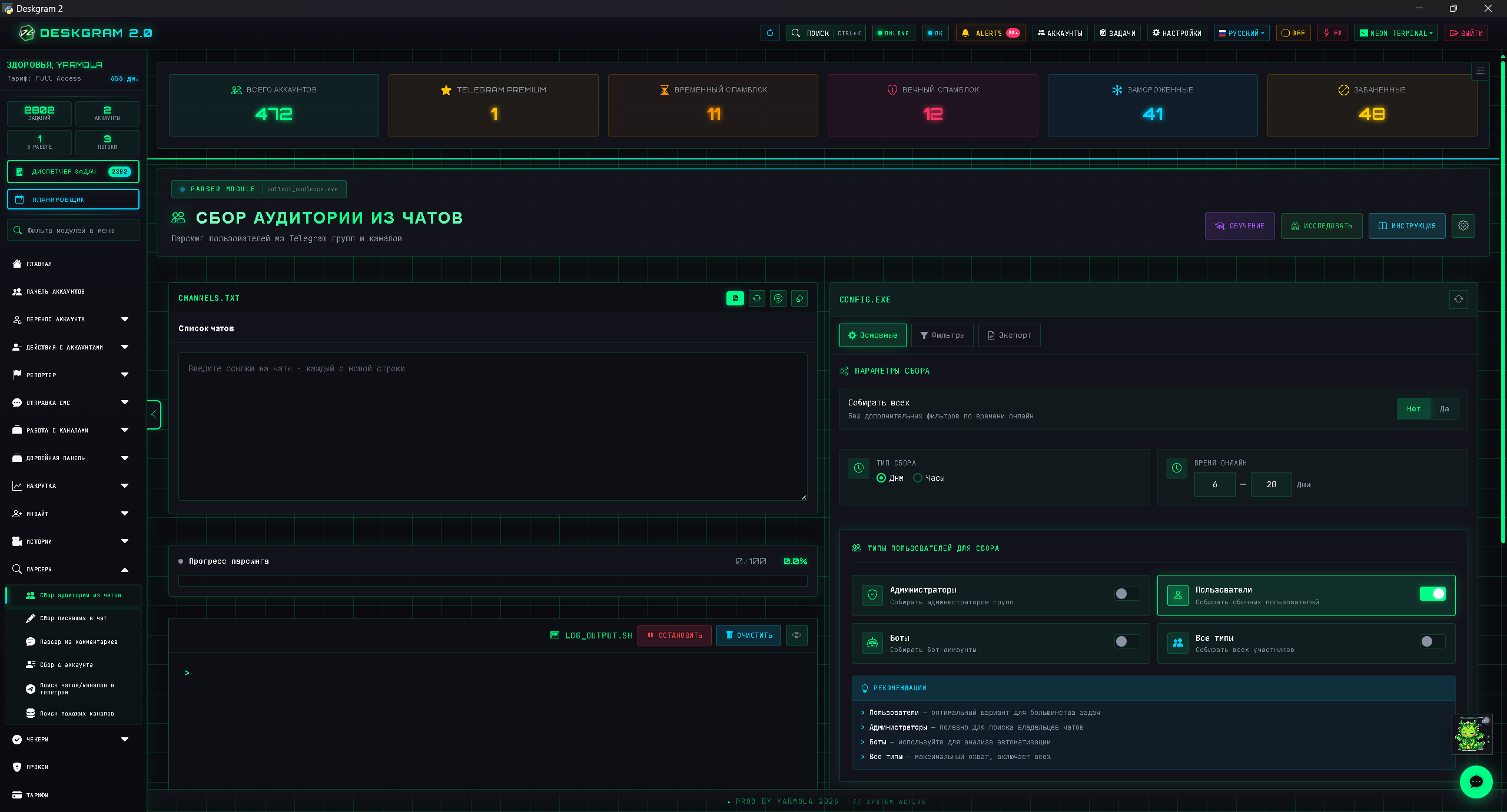
Deskgram 2 helps connect audience validation with the rest of the workflow: collection, checks, accounts, tasks, messaging, and invites. This matters when the audience is collected from several sources and then routed into different scenarios.
Useful entry points:
Connect quality checks with account safety
Audience quality and account safety are connected. A weak audience creates weak replies, complaints and repeated failed attempts. That pressure then hits accounts, proxies and Telegram API limits.
Before a larger Telegram automation launch, review:
- whether the audience source matches the offer;
- whether account warming is complete for the selected account group;
- whether proxy rotation is stable for those accounts;
- whether the first test batch produced errors or only weak marketing results;
- whether the message should be changed before volume increases.
This makes bulk messaging safety measurable instead of emotional.
Mini FAQ
Can I validate an audience only through a test campaign?
You can, but it is an expensive way to validate. It is better to remove obvious junk first, split the segments, and only then launch a small test.
What matters more: username or activity?
For delivery, contactability matters. For marketing, context matters. The ideal audience has both: the user is reachable and there is a clear reason why the user is relevant.
Should weak sources be stored somewhere?
Yes, at least in a separate list. That helps you avoid recollecting the same weak communities later.
Conclusion
Checking Telegram audience quality is a required step before any mass action. It helps you avoid burning accounts, messaging random users, and scaling low-quality sources.
A strong audience is not about maximum size. It is about clear context: source, activity, segment, scenario fit, and tested reaction quality.
If you treat validation as a mandatory filter, every next campaign becomes easier to understand. You see which sources generate replies, which segments stay silent, and where the weakness is in the collection logic rather than in the message text.