How to Collect an Audience From Telegram Channels and Chats
Audience collection in Telegram is one of the most important parts of growth. It is also one of the easiest stages to ruin if you treat it like a simple user export. A large dataset guarantees nothing on its own. What matters is where it came from, how closely users match your topic, whether they show signs of activity, and whether the audience can be used later without chaos.
Good parsing does not begin with the “collect” button. It begins with source understanding. A weak database increases cost, lowers conversion, damages messaging scenarios, and creates extra risk for accounts. That is why audience collection should be treated as the middle layer between discovery and communication.
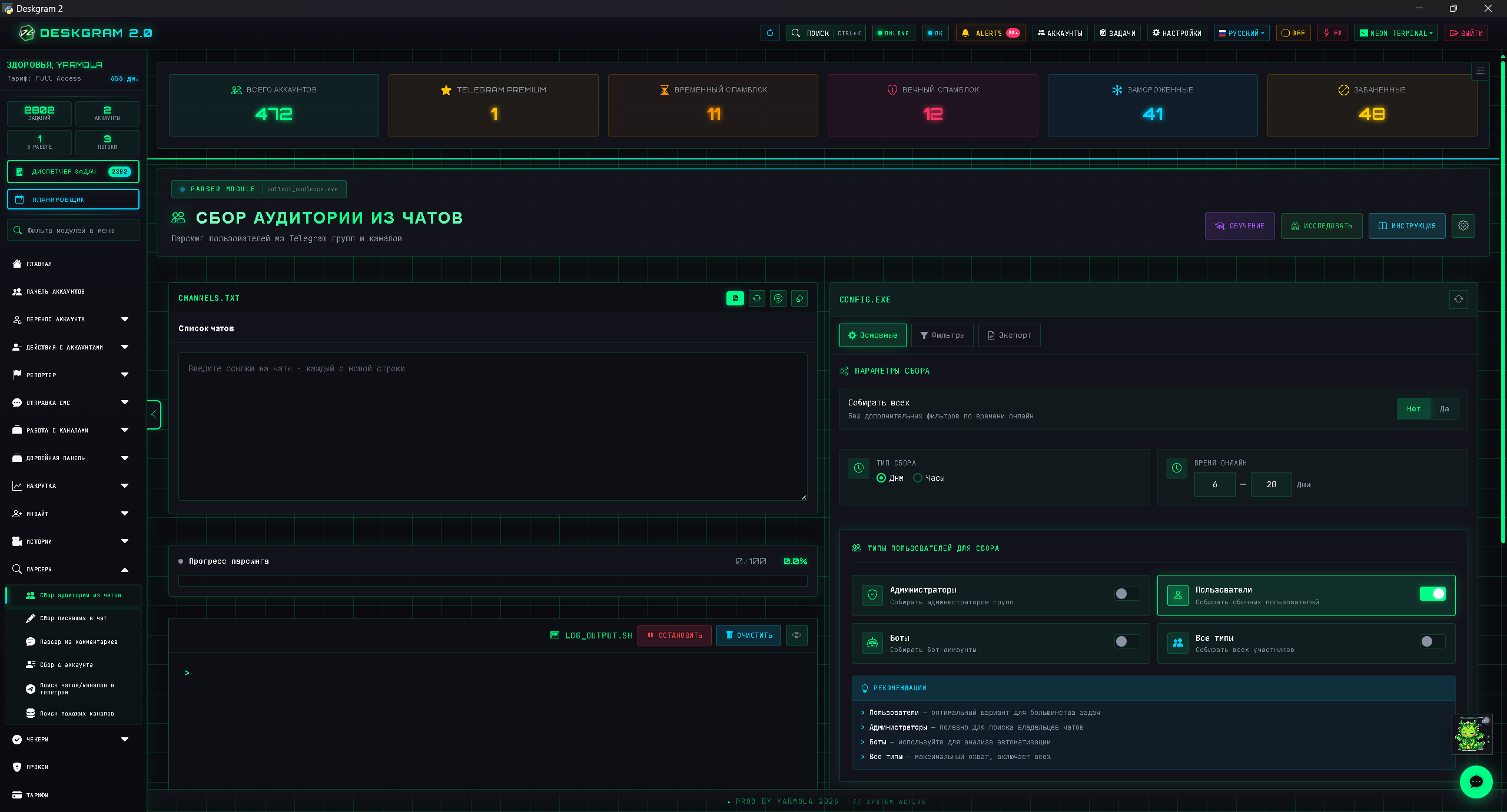
Where you can collect an audience
Telegram has several source types. Each of them gives different quality and fits different goals.
| Source | What you can get | When to use it |
|---|---|---|
| Public groups | Active participants in discussions | Outreach, pain analysis, invites |
| Channel-linked chats | Users reacting to content | Comments, direct messages, segmentation |
| Comments | People interested in a specific topic | Narrow scenarios |
| Participant lists | A broad thematic audience | Primary analysis and filtering |
| Users who posted in chats | A more active segment | Careful communication |
The strongest sources are the ones where the user has already taken an action: posted a message, left a comment, or joined a discussion. That kind of audience is usually warmer than a raw participant list.
Why quality matters more than size
One common mistake is evaluating the outcome by the number of exported rows. A database of 100,000 users may look impressive, but if half the audience is inactive, part of it is off-topic, and part came from junk sources, it may perform worse than a focused list of 5,000 relevant users.
Audience quality depends on a combination of factors:
- the source is related to your topic;
- the audience showed activity;
- the community does not look artificially inflated;
- the data can be segmented;
- the database does not mix unrelated niches without labels;
- the next scenario is already clear after collection.
If the next step is direct messaging, relevance matters the most. If the next step is market analysis, collection can be wider. If the next step is invites, interest and context alignment become more important.
How to prepare sources before parsing
Before collecting data, it helps to make a short source table. You can note the topic, source type, activity, expected scenario, and priority.
Example:
| Source | Type | Topic | Activity | Next step |
|---|---|---|---|---|
| Telegram Ads chat | Group | Ads | High | Collect active posters |
| Mini Apps channel | Channel with comments | Development | Medium | Collect from comments |
| SMM channel | Channel | Marketing | High | Analysis and similar channels |
This simple preparation layer helps you avoid throwing everything into one pile. It matters even more when you work with several segments at once: marketers, channel owners, arbitrage teams, agencies, or bot developers.
Which filters matter
The exact filtering logic depends on the module and the scenario, but the main principle stays the same: remove what should not move into the next action.
Basic filters:
- remove duplicates;
- separate active users from passive ones;
- discard obviously irrelevant sources;
- split the audience by source;
- preserve the context of where each user was found;
- avoid merging all segments without tags.
Source context is especially important. If a user was found in comments under a post about Telegram Ads setup, your message should look different from a message sent to a user from a bot-building chat.
Collecting from comments
Collecting users from comments is useful when you want people reacting to a very specific topic. This is a more precise layer than just exporting participants.
For example, if a channel posts about messaging problems in Telegram, users commenting under that post are already inside that pain point. You can work with them more carefully later through useful content, a bot, a consultation, a web preview, or soft outreach.
The main mistake is collecting comments without tracking the topic of the post. You need to know what the person reacted to. A comment under a meme or a random argument is not the same as a comment under a practical breakdown.
Collecting users who posted in chats
Users who posted in chats are often more valuable than passive participants. They already showed activity, asked a question, answered someone else, or joined the discussion.
That type of collection works well for:
- B2B scenarios;
- finding active niche participants;
- analyzing recurring questions;
- preparing audience segments for an autoresponder;
- soft private messaging scenarios.
But this layer still needs cleanup. Activity is not always useful activity. Some messages are valuable, some are spam, and some are meaningless noise. So after collection, you should assess not only the fact of activity, but also the quality of the source.
What to do after collection
A collected audience should not immediately move into a mass action. Between parsing and communication, you need an intermediate layer.
Recommended sequence:
- Review the sources.
- Remove duplicates and junk.
- Split the database into segments.
- Prepare different communication scenarios.
- Check accounts, proxies, and limits.
- Run a small test.
- Scale only what produces signal.
This lowers risk and helps you understand which sources actually work.
How not to carry junk into outreach
Outreach breaks when the database enters it without context. A user from a crypto chat, a user from comments under a bot-related post, and an owner of a Telegram channel are completely different people with different motives. The same copy will look random to them.
That is why the audience should preserve at least basic metadata:
- source;
- topic;
- collection date;
- activity type;
- expected scenario;
- priority.
Even simple segmentation increases the quality of downstream actions.
Where Deskgram 2 helps
In Deskgram 2, audience collection can be connected with channel search, similar-channel discovery, comment parsing, active-user parsing from chats, direct messaging, invites, and the autoresponder. That means you do not have to move data manually across ten separate tools. You can build one chain inside one system.
Useful web previews:
Safety layer after collection
Audience collection does not become useful until the next step is safe enough to run. Before bulk messaging or inviting, connect the list with account warming, proxy rotation and Telegram API limits.
The safer sequence is:
find sources -> collect users -> clean segments -> prepare accounts -> run a small test -> scale carefullyThis protects the campaign from two common problems: sending to a low-intent audience and burning accounts on a list that was never validated. Bulk messaging safety starts at the collection stage, not inside the sending module.
FAQ
Who is this article for?
This article is for teams that want to use Deskgram 2 for Telegram automation, audience growth, messaging or operational workflows.
Do I need warmed accounts and proxies?
In most bulk Telegram scenarios, warmed accounts, stable proxies, conservative limits and small tests reduce risk before scaling.
Where should I test the workflow?
Use the Deskgram 2 web preview links in the article to understand the module, then start with a small controlled task before launching a larger campaign.
Conclusion
Audience collection in Telegram is not a race for the biggest number of users. It is the process of preparing a quality segment for the next action. The better your sources are chosen and the better your context is preserved, the stronger your messaging, invites, comments, and autoresponder flows become.
If you build parsing as part of the funnel instead of as an isolated export, Telegram growth becomes more controllable: you understand where the audience came from, why it is relevant, and which scenario should come next.