Telegram Ads or Your Own Automation Infrastructure
When a business enters Telegram, one of the first questions is: should we use Telegram Ads or build our own automation system? In reality, these are not mutually exclusive. Advertising and automation solve different jobs, and strong growth usually comes from combining them.
Telegram Ads helps you buy attention inside the official ad network. Automation infrastructure helps you run the operational layer: finding sources, collecting audiences, preparing accounts, launching communication, testing workflows, handling replies, and building repeatable processes.
What Telegram Ads solves
Telegram Ads is a way to get paid reach. It is useful when you need to show a message to an audience quickly, test an offer, or support brand visibility.
Strong sides of advertising:
- an official ad channel;
- fast launch of reach;
- a clear paid-traffic model;
- the ability to promote a channel, bot, site, or product;
- a strong complement to content strategy.
If you already have a strong offer, a clear landing page, and test budget, Telegram Ads can give you a fast signal: is the topic interesting, do people click, which angles perform better?
What advertising does not solve
Advertising does not cover the full marketing stack. It can bring attention, but it does not replace the operational work inside Telegram.
Telegram Ads does not automatically solve:
- discovering niche channels and groups;
- collecting active audience segments;
- comment workflows;
- direct communication;
- account warming;
- task orchestration at scale;
- reply handling;
- linking channels, bots, and outreach into one system.
If a business has no infrastructure, ad traffic can disappear into a void. People click, ask questions, check the channel, but there is no system that processes interest after that.
Where your own infrastructure is necessary
Your own automation infrastructure becomes necessary when Telegram stops being just an ad platform and becomes an operating environment. Then you have channels, groups, bots, accounts, lists, comments, messaging, invites, AI scenarios, and repeatable workflows.
Examples of tasks:
- find channels and groups in the niche;
- collect audiences from active chats;
- prepare accounts before outreach;
- validate proxy rotation and Telegram API limits;
- launch careful direct messaging;
- answer inbound messages;
- comment on relevant posts with AI assistance;
- test multiple segments;
- compare source quality.
This is no longer an ad-cabinet task. It is the job of an operational growth system.
Comparison table
| Criterion | Telegram Ads | Automation Infrastructure |
|---|---|---|
| Main goal | Buy reach | Manage growth processes |
| Speed of first launch | High | Medium, needs setup |
| Source control | Via ad targeting | Via discovery and segmentation |
| Audience handling | Mostly via clicks | Via parsing, DMs, comments, and bots |
| Scaling model | Through budget | Through accounts, tasks, scenarios, and infrastructure |
| Main chaos risk | Budget and offer | Settings, lists, limits, and accounts |
| Best use case | Reach, offer testing, brand | Operational funnels, outreach, AI communication |
You cannot say one option is always better. If you need to test a message quickly, Ads is easier. If you need a complex and durable Telegram growth system, the automation layer is hard to replace.
How to combine paid and operational workflows
The strongest model is to use advertising and infrastructure together.
Example flow:
- Use Telegram Ads to bring people to a channel, bot, or site.
- In parallel, use channel discovery to study the niche and competitors.
- Collect active audience segments.
- Show up in relevant discussions through neuro-commenting.
- Handle targeted interest through DMs or an autoresponder.
- Control repeatability through tasks and scheduling.
In this setup, advertising creates the top layer of attention, while automation preserves operational depth.
When to start with advertising
Telegram Ads can come first if:
- you have test budget;
- the offer is already clear;
- you have a landing page, bot, or channel;
- you need to validate demand quickly;
- the team is ready to analyze metrics.
But even then, it is wise to prepare the processing layer in advance. If a user arrives from an ad and asks a question, there should be a clear next step.
When to start with automation
Automation should come first if:
- the niche is still being explored;
- you need to learn where the audience lives;
- chats, comments, and active users matter;
- the ad budget is limited;
- you need a long-term outreach system;
- the team wants to test different segments.
The first results may be slower, but you gain a market map and control over the process.
Why comparing only by price is misleading
Sometimes Telegram Ads and automation are compared only by cost: cost per click, subscriber, conversation, or lead. That matters, but it does not show the full picture.
Advertising buys attention, but it does not create your own knowledge base about the niche. Automation may require more setup, but it gives you reusable operating assets:
- lists of channels and groups;
- understanding of active sources;
- audience segments;
- message tests;
- reply data;
- working scenarios;
- account and task infrastructure.
These assets can be reused. The channels you discover later support competitor research, audience collection, neuro-commenting, and content strategy. That is why you should compare not just the cost of one action, but the contribution to the entire growth system.
What a hybrid strategy looks like
Hybrid strategy does not mean “launch everything at once.” It works in stages.
First, use automation to study the niche: find sources, collect initial segments, learn the audience language, and identify recurring questions. Then turn those insights into Telegram Ads hypotheses. After the ad test, route users back into your infrastructure: bot, channel, autoresponder, guides, web preview, or direct conversation.
Example loop:
- Discovery shows what the audience discusses.
- Parsing and comment analysis reveal pain points.
- Those pain points become ad hypotheses.
- Telegram Ads validates demand.
- Inbound interest is processed through a bot, DMs, or an autoresponder.
- The strongest themes return into content and new automation scenarios.
That is how paid traffic and your own infrastructure begin to reinforce one another.
The role of Deskgram 2
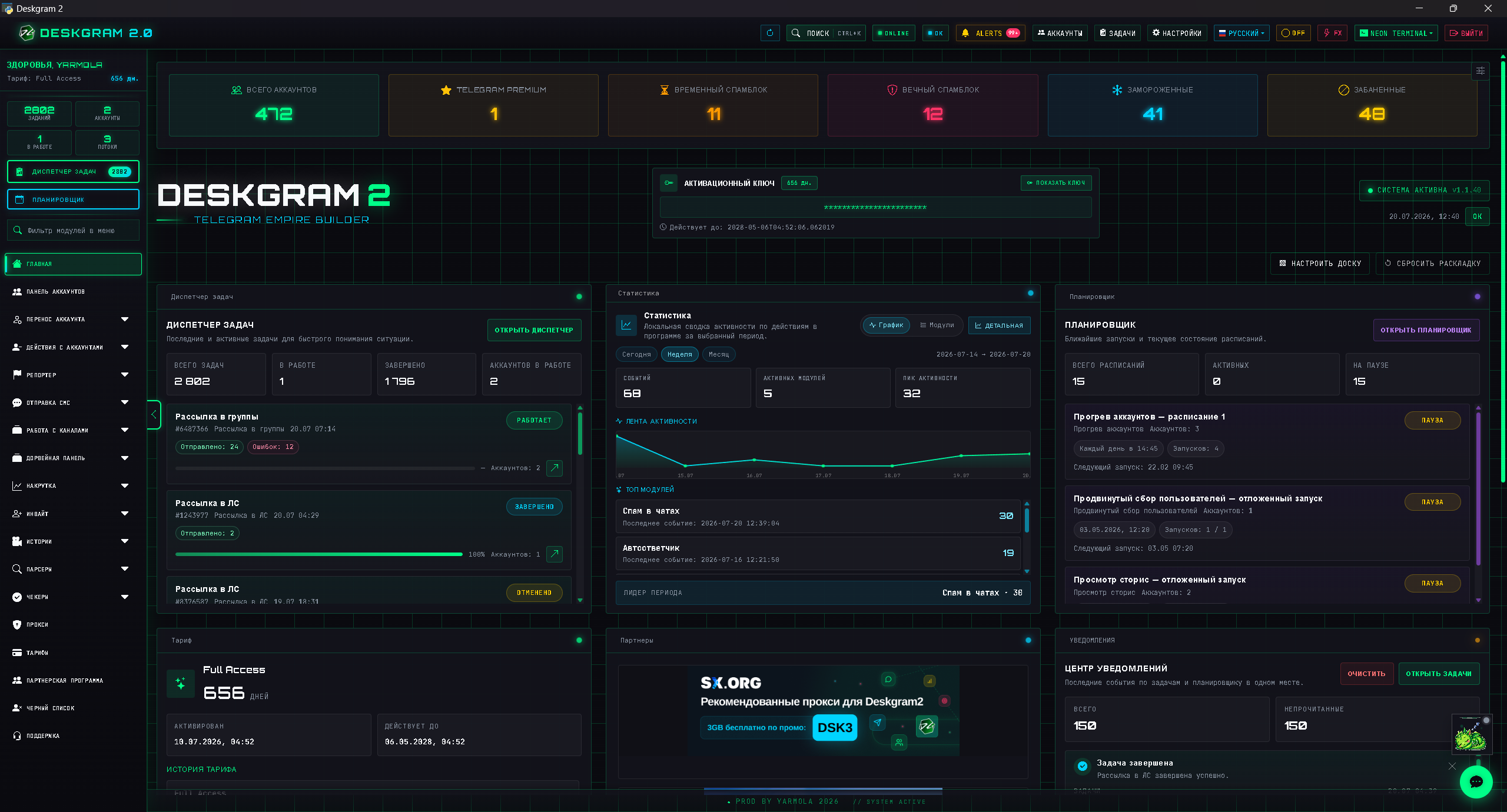
Deskgram 2 belongs to the infrastructure layer. It does not replace the ad cabinet. It handles what surrounds ads and comes after them: source discovery, audience collection, accounts, proxy rotation, account warming, messaging, comments, AI workflows, tasks, and module web previews.
Useful entry points:
- Deskgram 2 main web preview;
- channel and group discovery;
- audience collection;
- neuro-commenting;
- direct messaging.
How to choose the approach
If we simplify it, the choice depends on the question you are solving.
If the question is “how do we get reach quickly,” look at Telegram Ads. If the question is “how do we work systematically with the niche, audience, and communication,” you need infrastructure. If the question is “how do we scale Telegram as a marketing and sales channel,” you will almost always need a combination.
Practical approach:
- Define the offer.
- Find and study niche sources.
- Validate the audience and segments.
- Launch small automation tests.
- Add paid traffic where the economics are clear.
- Process interest through a bot, site, DMs, or an autoresponder.
FAQ
Who is this article for?
This article is for teams that want to use Deskgram 2 for Telegram automation, audience growth, messaging or operational workflows.
Do I need warmed accounts and proxies?
In most bulk Telegram scenarios, warmed accounts, stable proxies, conservative limits and small tests reduce risk before scaling.
Where should I test the workflow?
Use the Deskgram 2 web preview links in the article to understand the module, then start with a small controlled task before launching a larger campaign.
Conclusion
Telegram Ads and automation infrastructure are not direct competitors. Ads buys attention. Infrastructure helps you understand the market, collect audiences, manage accounts, launch communication, and process interest.
If you use only advertising, you may get reach without depth. If you use only automation without strategy, you may get activity without clear economics. A strong Telegram system appears when paid traffic and operational workflows work together.