Telegram Ads vs Your Own Automation Infrastructure: What Each Side Actually Solves
Telegram Ads and your own automation infrastructure do not replace each other. They solve different layers of Telegram growth. Ads buys reach. Automation helps you find an audience, build workflows, manage accounts, launch communication, and handle inbound interest.
So the real question is not “which one is better,” but “which job are we trying to solve right now?”
What Telegram Ads gives you
Telegram Ads is useful when you need official paid reach. It helps you show a message to the right audience quickly, test an offer, and send people to a channel, a bot, or a website.
Ads is a strong fit for:
- rapid demand testing;
- brand support;
- channel promotion;
- product launches;
- paid acquisition at the top of the funnel.
But ads alone do not solve the operational work that starts after the click.
What automation infrastructure gives you
Automation covers the layer around advertising and after advertising:
- channel and group discovery;
- audience collection;
- list validation;
- account warming;
- bulk messaging safety workflows;
- comments and social-touch campaigns;
- autoresponder logic;
- AI communication;
- tasks and logs.
This is not just an “alternative to ads.” It is the operational layer of Telegram marketing.
Comparison
| Criterion | Telegram Ads | Automation |
|---|---|---|
| Main job | Buy reach | Manage processes |
| Speed of launch | High | Requires setup |
| Audience control | Through ad settings | Through discovery and segments |
| Work after interest appears | Limited | Deep |
| Repeatability | Through budget | Through task systems |
| Best result | With a strong offer | With strong infrastructure |
If you need fast reach, Ads is more convenient. If you want to build a repeatable Telegram system, automation is essential.
How to combine them
A strong strategy can look like this:
- Automation helps you study the niche.
- Discovery reveals channels and topics.
- Parsing and comment analysis uncover real pain points.
- Ads tests the offer and message.
- Inbound interest is handled through a bot, site, DM flow, or autoresponder.
- The best-performing topics feed new content and new campaigns.
That is how paid traffic and your own infrastructure amplify each other.
Mistakes in choosing
The first mistake is expecting ads to compensate for a weak product, weak content, or poor lead handling.
The second mistake is launching automation without a strategy and calling any activity “growth.”
The third mistake is comparing only the cost per click or per message. You need to look at the full funnel.
The fourth mistake is not connecting ads with guides, web previews, and follow-up handling.
Decision matrix
| Situation | What to choose |
|---|---|
| You need to test an offer quickly | Telegram Ads |
| You need to find the right audience in the niche | Automation |
| You need raw reach | Telegram Ads |
| You need a reusable base and segments | Automation |
| You have budget but no inbound handling | Infrastructure first |
| You have infrastructure but not enough reach | Add Ads |
The core rule is simple: advertising strengthens whatever can already process interest. If that processing layer is missing, paid traffic loses efficiency very quickly.
What to do first
If you still have not clarified the audience, pains, offer, and next step, it is usually smarter to start with automation and content. Channel discovery, comments, parsing, and guides help you understand what the market actually cares about.
If the offer is already clear and you have a site, bot, or channel, you can launch Ads to test reach. But even then, prepare your autoresponder, web preview, and support materials in advance.
Mini FAQ
Can you replace Ads with messaging campaigns?
No. These are different formats. Messaging is direct outreach. Ads gives you paid reach.
Which one is cheaper?
It depends on the niche, the offer, the quality of the base, and your team. Compare the cost of the end result across the whole funnel, not just one click.
Why do you still need automation if you have ads?
Because ads do not discover channels, collect audiences, warm accounts, answer users, or build operational workflows around Telegram API limits and follow-up.
Step-by-step rollout plan
If you are building Telegram growth from scratch, a healthy path is:
- Describe the audience and the offer.
- Find channels and groups in the niche.
- Collect the first segments.
- Validate themes through comments and content.
- Prepare guides and web previews.
- Set up a bot or autoresponder.
- Launch a small Ads test.
- Compare paid traffic with organic and automation-based scenarios.
If ads bring clicks but not leads, do not rush to raise the budget. The problem may sit in the landing page, the offer, inbound handling, or the lack of a clear next step.
What to measure
For Ads, track not only clicks and CPC, but also traffic quality: what the user did after the click, whether they asked a question, opened a web preview, or reached the bot.
For automation, look at list quality, replies, click-throughs, test cost, repeatability, and the load on accounts.
Do not compare one channel against another in isolation. Compare the contribution of each layer to the whole funnel.
How to avoid imbalance
If you invest only in Ads, you may become fully dependent on budget. If you invest only in automation, you may create activity without enough reach. Balance appears when advertising brings attention and infrastructure knows how to process that attention.
A Deskgram 2 example
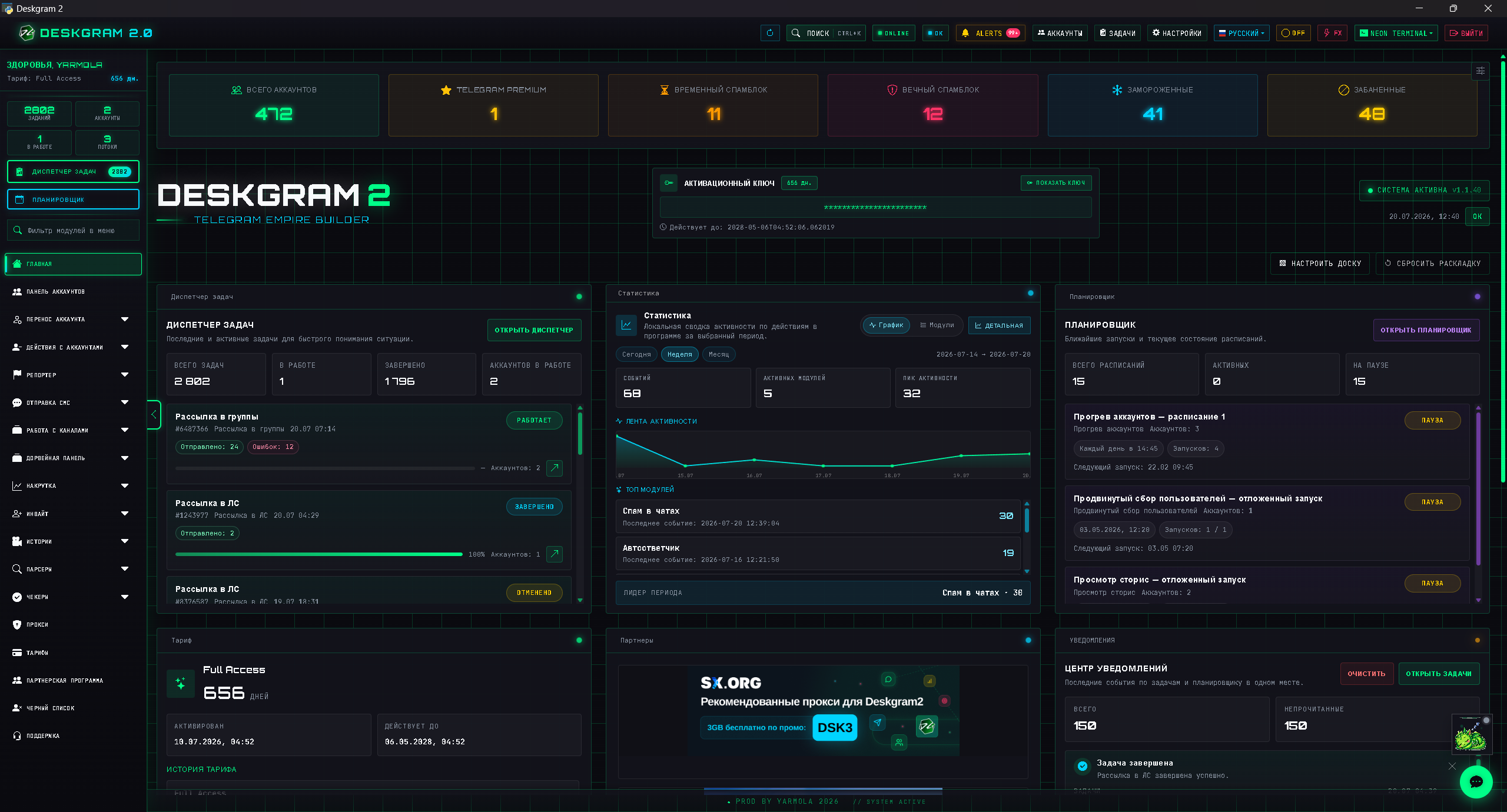
For a complex product like Deskgram 2, advertising may bring a user to the site, but the user still needs to understand the interface, modules, scenarios, and safety model. That means paid traffic should never lead into a vacuum. It should land in a prepared structure: guides, web preview, FAQ, bot, and a clear next step.
Automation helps from the other side: it finds the audience, reveals recurring topics, creates content hypotheses, runs comment flows, collects bases, and processes interest.
Readiness criteria before Ads
Before you spend on ads, check that you have:
- a landing page;
- a clear offer;
- guides that explain the product;
- a working web preview;
- a system for handling inbound questions;
- analytics for transitions;
- a team that knows what to do after the click.
If these conditions are missing, strengthen the infrastructure first. Then the ad budget will support a funnel instead of random traffic.
When to scale advertising harder
You should increase ad spend when you already understand which pages convert, which guides users read, which modules attract attention, and which questions show up after the click. Then Ads scales a proven system instead of scaling a guess.
If people click and leave immediately, first improve the content, web preview, offer, and inbound handling. Raising the budget in that situation only helps you discover the weak spot faster.
Where Deskgram 2 helps
Useful entry points:
Conclusion
Telegram Ads buys attention. Automation turns attention, audience data, and communication into a system. If you use only ads, you may lose the user right after the click. If you use only automation without a strong offer, you may get activity without economics.
The strongest approach is to combine both layers: paid reach for testing and scaling, infrastructure for depth, processing, and repeatability.